What size power station runs a refrigerator, and for how long?
The fridge is the first thing most people want to save in an outage. The good news is that it needs less power than you might think, because the compressor only runs part of the time. Here is how to pick a power station that can actually start and run your fridge, and how to make the battery last.
Foxterr Power is reader supported. We may earn a commission when you buy through links on our site, at no extra cost to you. How we make money.
In this guide
How much power does a fridge use?
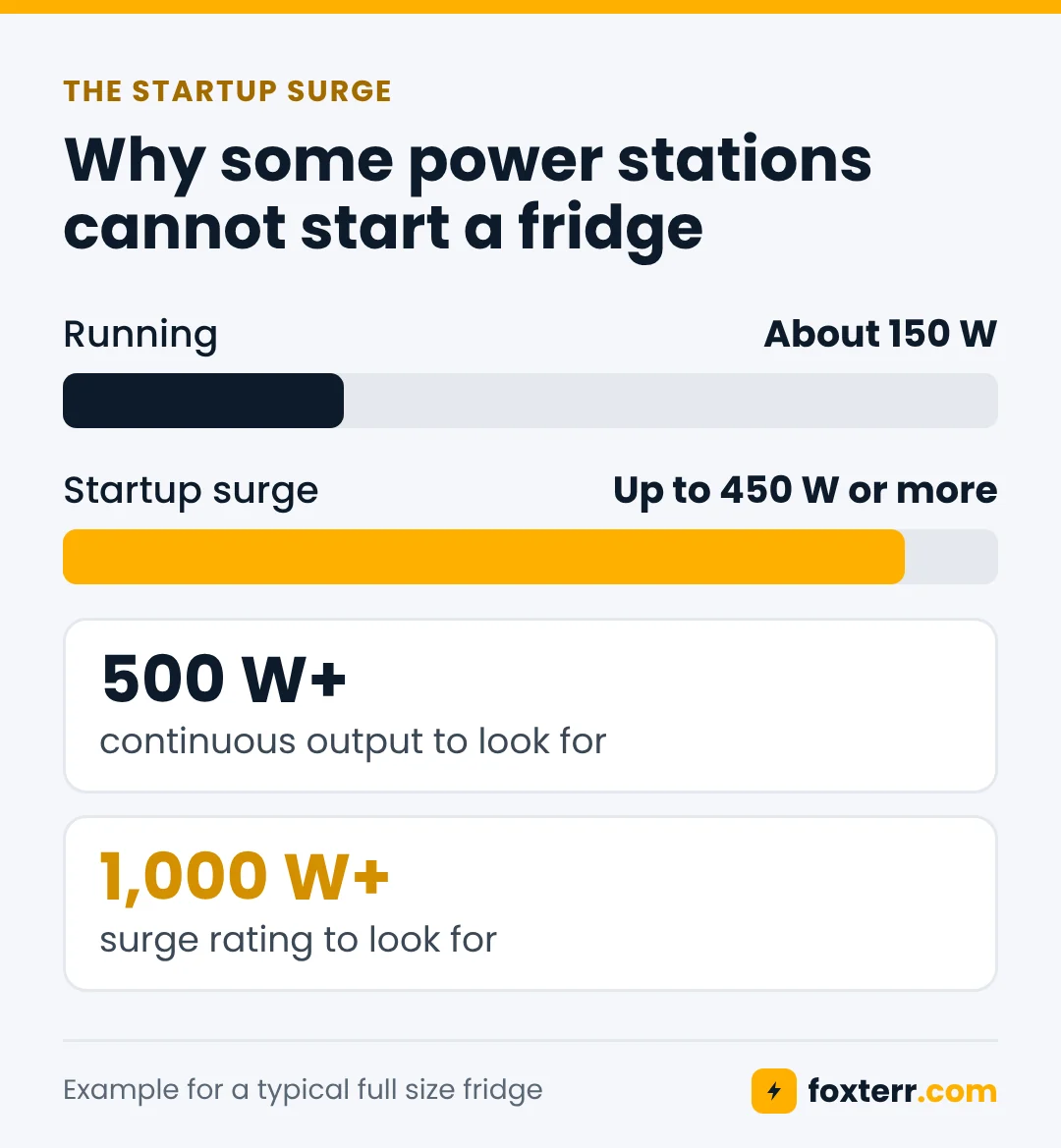
A modern full size refrigerator draws about 100 to 200 watts while the compressor runs. Over a whole day most use roughly 1 to 2 kilowatt hours (1,000 to 2,000 Wh). Older fridges, side by side models and fridges with an ice maker can use more.
To find your own number, check the yellow EnergyGuide label or the manual for yearly use in kWh, then divide by 365. You can also look up your model on ENERGY STAR. A fridge rated at 550 kWh a year uses about 1.5 kWh a day.
The startup surge: why some stations fail
When the compressor kicks on, it pulls a short burst of power, often two to three times its running watts. A fridge that runs at 150 watts may need 450 watts or more for a second or two. If the power station cannot supply that burst, it shuts off or the fridge never starts.
How long will a power station run a fridge?
Using real world capacity of about 85 percent and a typical fridge, here is what to expect. Room temperature, how full the fridge is and how often the door opens all change the result.
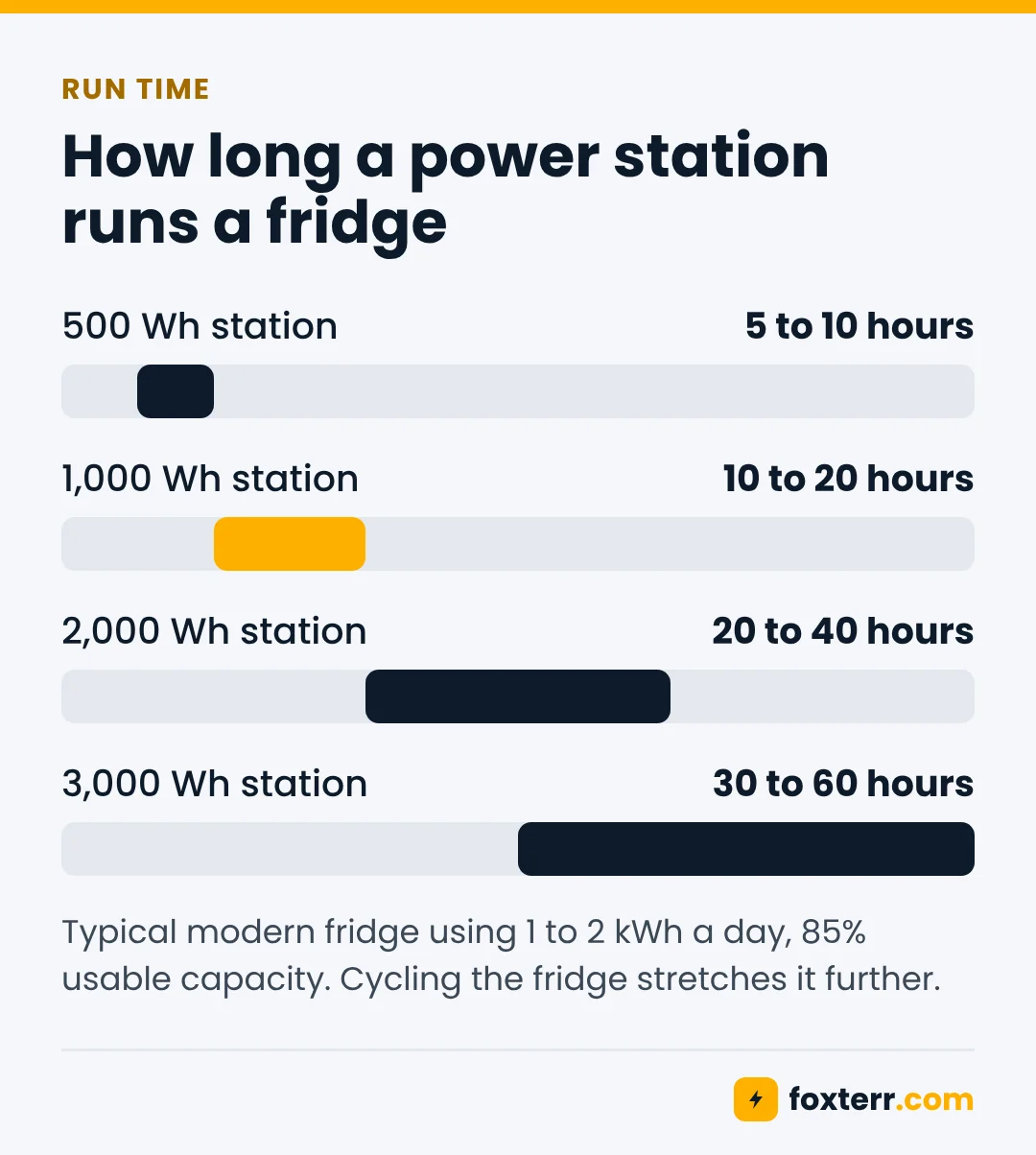
| Power station capacity | Estimated fridge run time |
|---|---|
| 500 Wh | About 5 to 10 hours |
| 1,000 Wh | About 10 to 20 hours |
| 2,000 Wh | About 20 to 40 hours |
| 3,000 Wh and up | About 30 to 60 hours |
Need to power more than the fridge? Add up the rest of your list with our power station sizing guide.
Make the battery last longer
- Keep the door closed. Every opening lets cold air out and makes the compressor work harder.
- Run the fridge in cycles. Power it for an hour, then unplug it for two or three hours. FoodSafety.gov says a closed fridge keeps food safe for up to 4 hours without power, so cycling can double or triple your run time.
- Keep it full. Jugs of water work well. A full fridge holds cold far better than an empty one.
- Turn off the ice maker and water dispenser. They add load you do not need.
- Move drinks to a cooler. Fewer fridge openings, less wasted cold.
- Add solar. Even one or two panels can refill a good share of a day's fridge use. See our solar generator guide.
Keep food safe
Food in the fridge should stay at 40 degrees Fahrenheit or below. A cheap appliance thermometer takes the guesswork out. Follow FoodSafety.gov's power outage chart and throw away perishable food that sat above 40 degrees for more than 2 hours.
For the full plan covering water, light and safety, use our power outage checklist.
Fridge buyer checklist
- Capacity of 1,000 Wh or more for a full day of fridge use
- Continuous output of 500 W or more, surge of 1,000 W or more
- Pure sine wave AC output
- LiFePO4 battery for long life. See LiFePO4 vs lithium ion
- Solar input high enough to recharge in a day
Test your setup before you need it
- Charge the power station to 100 percent.
- Unplug the fridge from the wall and plug it into the station.
- Wait for the compressor to start. If the station shuts off, its surge rating is too low.
- Leave it running for an hour and note how much charge it used.
- Multiply that hourly use by 24 for a rough daily figure, then plug the fridge back into the wall.
This 1 hour test tells you more than any spec sheet. Do it on a normal day, not during a storm.
Fridge, chest freezer or mini fridge?
| Appliance | Power use | Notes |
|---|---|---|
| Full size fridge | Moderate | Most common outage priority |
| Chest freezer | Often lower | Well insulated. Holds cold for a long time |
| Upright freezer | Moderate | Loses cold faster than a chest freezer when opened |
| Mini fridge | Lower | Handy for medication or essentials only |
If medication must stay cold, a mini fridge on a power station is an efficient way to protect it during a long outage. Ask your pharmacist how long your medication can stay at room temperature.
Fridge plus everything else
The fridge rarely runs alone. Add a router, lights and phone charging and your daily total climbs. Our sizing guide includes a worked example of a full day plan, and our LiFePO4 guide explains which battery type lasts longest if you plan to cycle the fridge often.
Frequently asked questions
Can a 500 W power station run a refrigerator?
Sometimes. It depends on the fridge's startup surge. Many stations rated at 500 W continuous have a higher surge rating that can start a small or efficient fridge. For a full size fridge, 1,000 W of output or more is safer.
How long will a 1,000 Wh power station run a fridge?
About 10 to 20 hours for a typical modern fridge, and longer if you run it in cycles and keep the door closed.
Do I need a pure sine wave power station for a fridge?
It is strongly recommended. Motors and compressors run cooler and more reliably on pure sine wave power.
Can I keep a chest freezer running with a power station?
Yes, and chest freezers are often easier, because they are well insulated and use less power than a full fridge. A full freezer also holds its temperature for about 48 hours without power.
Will a power station damage my refrigerator?
Not if it has a pure sine wave inverter and enough surge capacity. Underpowered or modified sine wave units are the ones to avoid.
Is it better to run the fridge all the time or in cycles?
Cycles stretch your battery much further. Run it for about an hour every few hours and keep the door closed in between.
This article gives general information only. Always follow the safety instructions for your own equipment, and ask your doctor or equipment supplier about any medical device.