Power outage checklist: how to prepare, what to do, and what to check after
Most outages are short, but storms, heat waves and winter weather can leave homes dark for days. A little preparation turns a stressful night into a minor inconvenience. Use this checklist before storm season, keep it on the fridge, and you will know exactly what to do.
Foxterr Power is reader supported. We may earn a commission when you buy through links on our site, at no extra cost to you. How we make money.
In this guide
Before an outage: build your kit
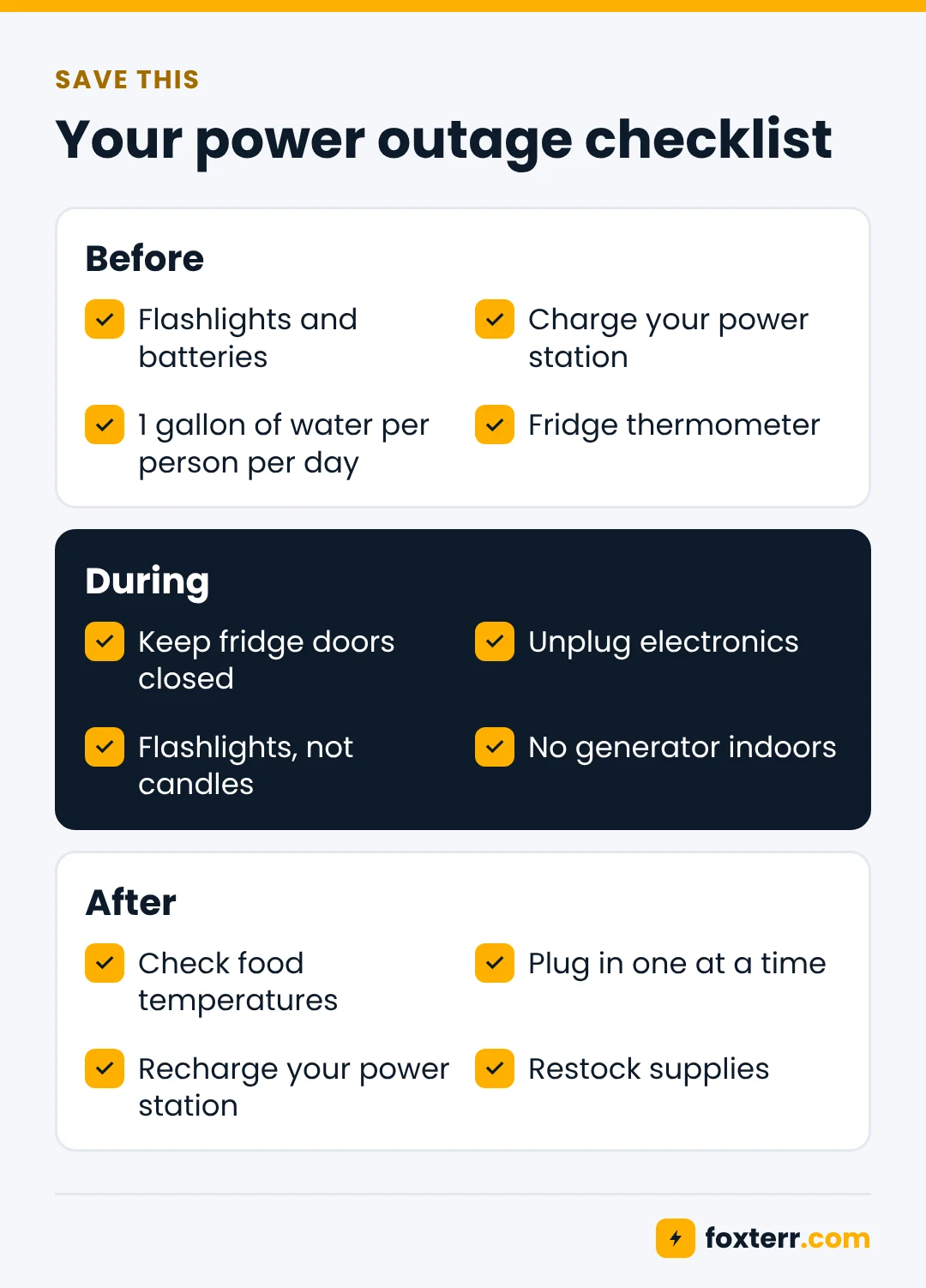
Start by listing everything in your home that needs electricity, especially anything critical like medical devices or medication that must stay cold. Ready.gov recommends exactly this inventory as the first step. Then gather the basics.
- Flashlights or lanterns for every room, with spare batteries
- Phones, power banks and your power station fully charged when a storm is forecast
- Drinking water: about one gallon per person per day for several days
- Food that needs no cooking or refrigeration for a few days
- A refrigerator and freezer thermometer, so you know if food stayed safe
- Some cash, since card machines and ATMs may not work
- Battery powered or hand crank radio for local updates
- Carbon monoxide detectors with battery backup on every floor
Plan your backup power
Decide what you must keep running and how. For most homes that means the fridge, router, lights, phones and any medical device. A portable power station handles all of that silently indoors. Our sizing guide helps you pick the right capacity, and if you rely on a CPAP, read our CPAP backup power guide.
If you own a gas generator, store fuel safely and test it before you need it. Our power station vs generator comparison explains when each makes sense.
During an outage: stay safe and save power
- Keep fridge and freezer doors closed as much as possible
- Unplug sensitive electronics to protect them from a surge when power returns
- Use flashlights, not candles, to lower the fire risk
- Never run a generator, grill or camp stove indoors or in a garage. The CDC says generators belong outside, more than 20 feet from windows, doors and vents
- Check on elderly neighbors and anyone who lives alone
- Report the outage to your utility, and treat every downed line as live. Stay well away and report it
- In extreme heat or cold, go to a community cooling or warming center if your home becomes unsafe
How long food stays safe without power
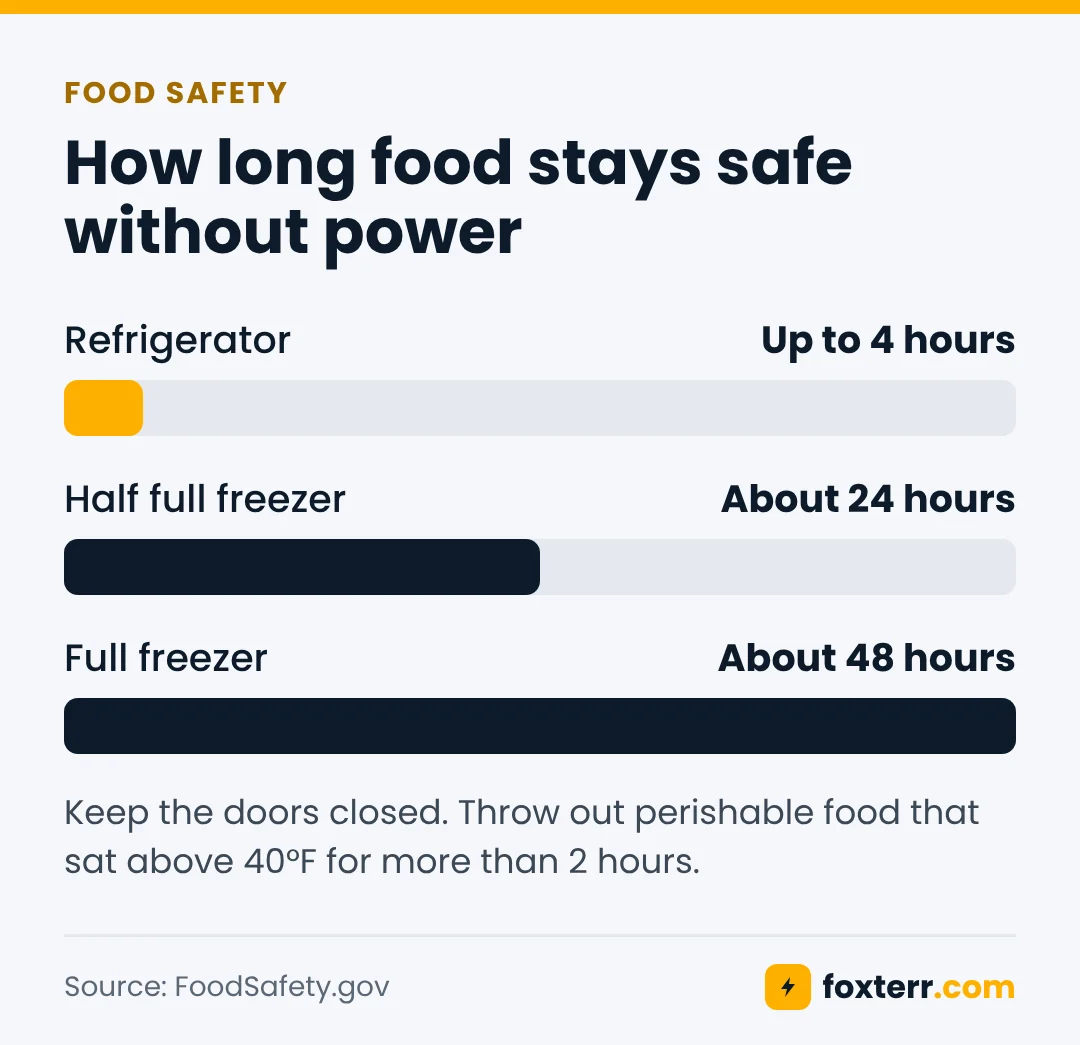
According to FoodSafety.gov, a closed refrigerator keeps food safe for up to 4 hours. A full freezer holds its temperature for about 48 hours, and a half full freezer for about 24 hours, if the door stays closed.
A power station can stretch those times a lot. Running the fridge for an hour every few hours keeps it cold while using a fraction of the battery. Our refrigerator guide shows exactly how.
Stretch your backup power
- Power only what you need, and unplug devices once they are charged
- Charge phones and laptops from USB ports, which waste less energy than AC outlets
- Turn off the fridge ice maker and water dispenser
- If you have solar panels, set them up in the morning for the strongest sun. See our solar guide
After the power comes back
- Check fridge and freezer temperatures. Throw out perishable food that sat above 40 degrees Fahrenheit for more than 2 hours. When in doubt, throw it out
- Plug appliances back in one at a time to avoid a surge
- Recharge your power station and power banks straight away
- Restock water, batteries and anything else you used
- Write down what worked and what you wished you had, while it is fresh
Then put your power station back into storage the right way. Our storage and maintenance guide keeps it ready for next time.
Special situations
Medical devices and medication
Ready.gov advises finding out how long your medication can be stored at higher temperatures and getting specific guidance for any medication that is critical for life. If you use a powered medical device, plan a backup source and ask your provider about it. Our CPAP guide covers sizing for sleep therapy.
Winter outages
- Dress in layers and close off rooms you do not need
- Never use an oven, grill or camp stove to heat your home
- Let faucets drip slightly in extreme cold to help keep pipes from freezing
- If your home gets dangerously cold, go to a warming center
Summer heat
- Drink water often and stay in the coolest room of the house
- Keep blinds closed during the day
- A small fan uses little power. Run it from your power station's USB or AC port
- Check on older neighbors and anyone with health conditions
Working from home
A router uses about 15 W and a laptop about 60 W. Together that is roughly 75 W, so a 1,000 Wh power station keeps you online for about 11 hours. If your internet provider's equipment down the street loses power, though, a phone hotspot may be your only option, so keep phones charged too.
Make a simple family plan
- Agree on where the flashlights and power station live
- Write down your utility's outage number and report page
- Decide who checks on older relatives or neighbors
- Keep a printed list of important phone numbers in case phones die
Frequently asked questions
What should I do first when the power goes out?
Check whether neighbors have power, report the outage to your utility, keep fridge and freezer doors closed, unplug sensitive electronics and switch to flashlights.
How long will food last in the fridge without power?
Up to 4 hours if the door stays closed, according to FoodSafety.gov. A full freezer stays safe for about 48 hours and a half full one for about 24 hours.
What should be in a power outage kit?
Flashlights, spare batteries, charged power banks or a power station, water, food that needs no cooking, a fridge thermometer, cash, a radio and any medication you need.
Is it safe to use a generator during a power outage?
Only outdoors, more than 20 feet from windows, doors and vents, as the CDC advises. A battery power station is the safe option for indoor use.
How do I keep my phone charged during a power outage?
Use a power bank or a portable power station, charging from USB ports to save energy. Turn on low power mode and lower screen brightness.
How much water should I store for a power outage?
About one gallon per person per day, for several days. Remember pets too.
This article gives general information only. Always follow the safety instructions for your own equipment, and ask your doctor or equipment supplier about any medical device.