Best power station for CPAP: how to choose backup power for sleep therapy
If you use a CPAP machine, a power outage at night is more than an inconvenience. A small, quiet battery power station can keep your therapy running safely indoors. This guide shows how to size one for your machine and settings, and what features actually matter.
Foxterr Power is reader supported. We may earn a commission when you buy through links on our site, at no extra cost to you. How we make money.
In this guide
Talk to your provider first
Your doctor or equipment supplier knows your machine and your therapy needs. Ask them about backup power before you need it, and check your machine's manual for its power supply and any approved DC adapter. Ready.gov also advises anyone who relies on a medical device to plan for outages ahead of time.
How much power does a CPAP use?
Most CPAP machines use about 30 to 60 watts on their own. Turn on the heated humidifier and heated tubing and use can climb to 90 watts or more. That one setting can double or triple the battery you need.
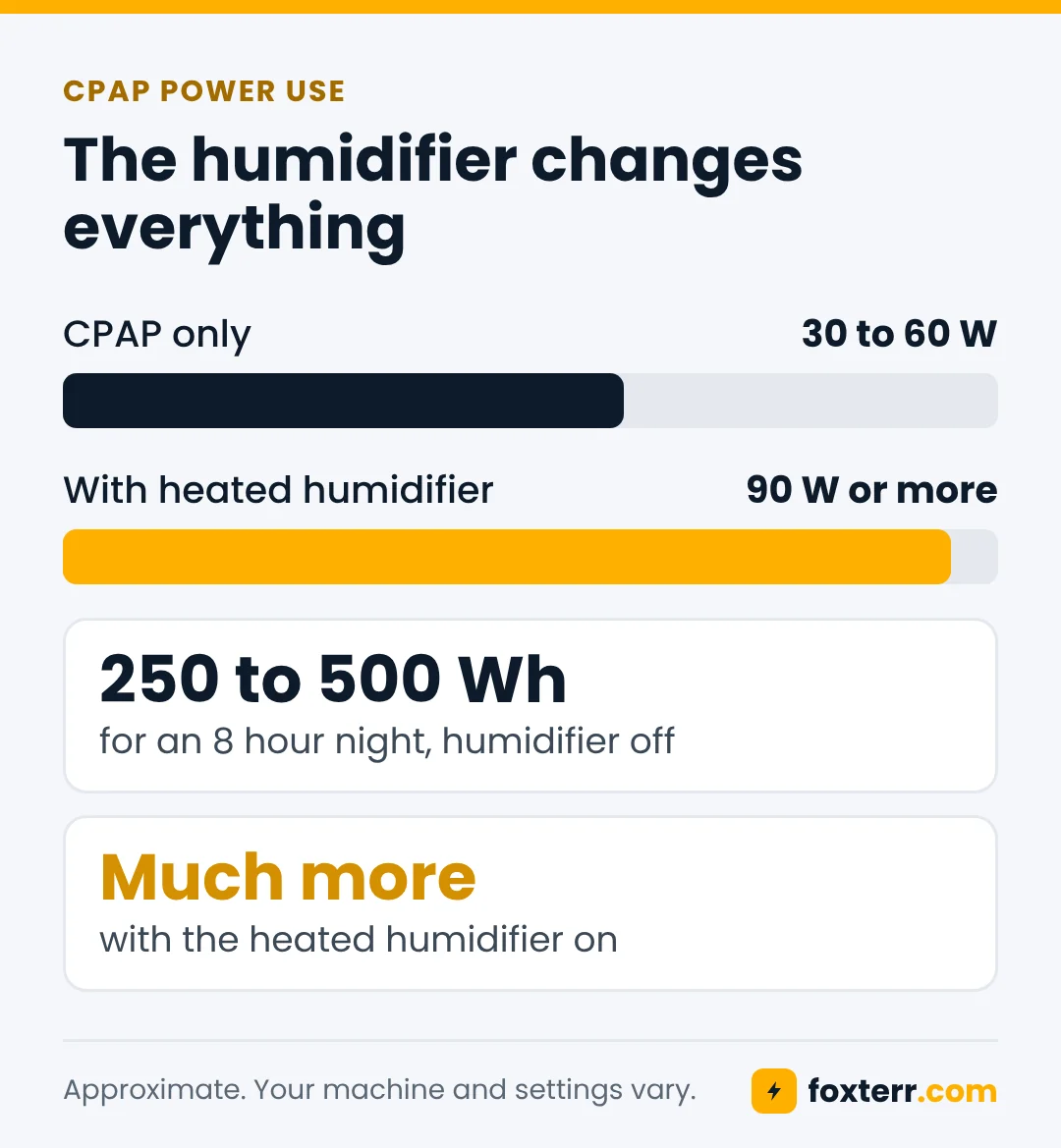
For an 8 hour night, that works out to roughly 250 to 500 Wh without humidification and much more with it. Use the formula from our sizing guide: run time = capacity × 0.85 ÷ watts.
How to choose a power station for CPAP
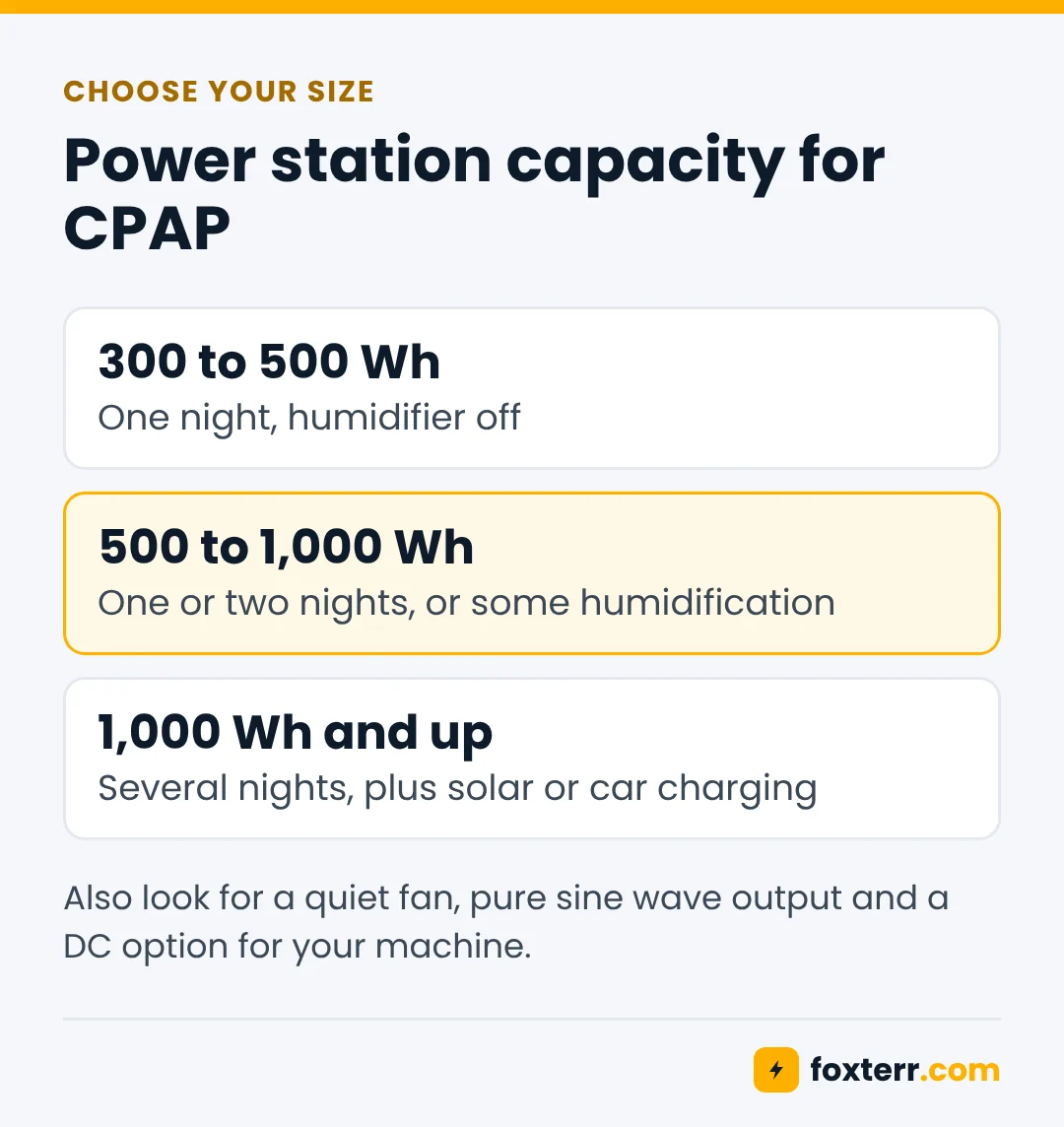
| Your need | Capacity to look for |
|---|---|
| One night, humidifier off | 300 to 500 Wh |
| One or two nights, or some humidification | 500 to 1,000 Wh |
| Several nights | 1,000 Wh or more, plus a way to recharge |
- Quiet operation. A loud cooling fan beside the bed defeats the purpose. Look for low noise ratings or reviews that mention quiet running.
- Pure sine wave AC output. The safe choice for medical devices.
- DC output that matches your machine. Running from DC skips the inverter and can add hours of run time.
- UPS or pass through mode. Keeps your CPAP running while the station is plugged in, and switches over quickly if the grid drops in the night.
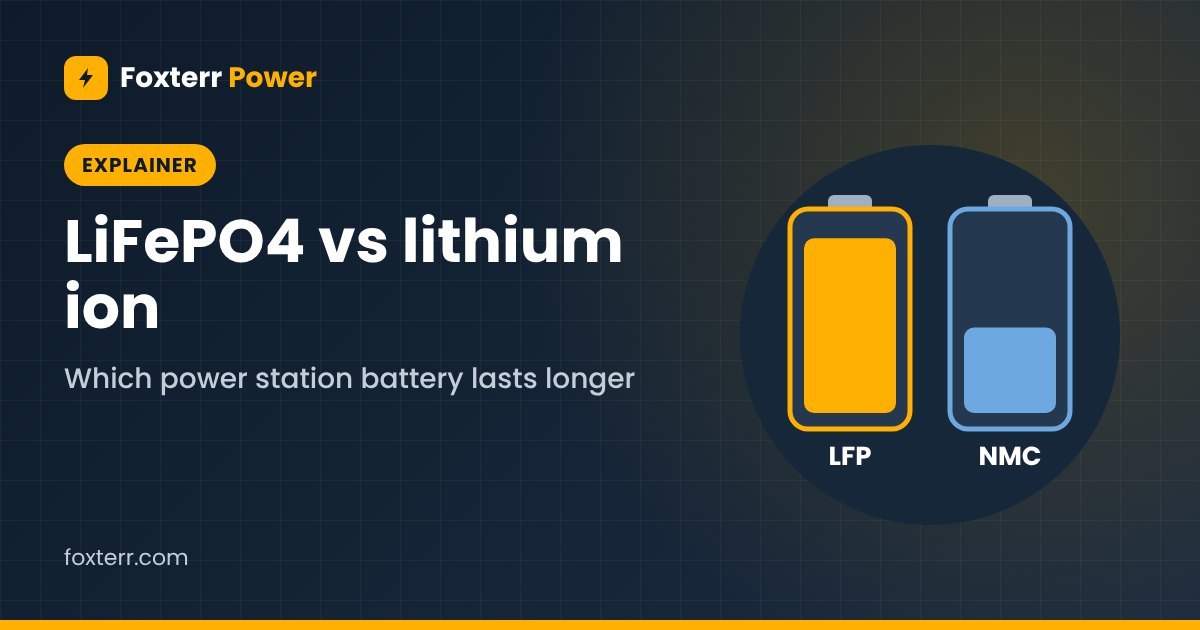
- LiFePO4 battery. Lasts for thousands of cycles. See LiFePO4 vs lithium ion.
- Solar input. For outages longer than a night. See our solar generator guide.
Ways to stretch run time
- Turn off the heated humidifier and heated tube during an outage, if your provider agrees
- Use the manufacturer's DC power cord if one exists for your machine
- Charge the station to 100 percent whenever a storm is forecast
- Keep a second charging option, like solar panels or a car charger, for longer outages
Safety reminders
Never run a gas generator indoors or in a garage to power a CPAP. Carbon monoxide is deadly. A battery power station produces no fumes and is safe in the bedroom. Our power station vs generator guide covers the differences in more detail.
Some utilities keep a list of customers who rely on medical equipment and may prioritize them or send outage alerts. Ask yours whether it offers this, and keep our power outage checklist handy.
Worked example: how many nights will it last?
Say your CPAP uses 40 W with the humidifier off and you sleep 8 hours. That is 320 Wh a night. A 500 Wh station gives about 425 Wh of usable energy, so roughly 1.3 nights. A 1,000 Wh station gives about 2.6 nights. Turn on a humidifier that adds 50 W and the same 1,000 Wh station lasts barely more than one night.
| Station | Humidifier off (40 W) | Humidifier on (90 W) |
|---|---|---|
| 500 Wh | About 1.3 nights | About half a night |
| 1,000 Wh | About 2.6 nights | About 1.2 nights |
| 2,000 Wh | About 5 nights | About 2.4 nights |
DC vs AC: why it matters
Most CPAP machines run on DC power internally. When you plug the AC power brick into a power station, the station converts its DC battery power into AC, and then the brick converts it back to DC. Each conversion wastes energy. A DC cord made for your machine skips both steps, which can add meaningful run time on the same battery.
Questions to ask your provider
- Is it safe for me to skip the humidifier for a night or two?
- Does my machine have an approved DC power cord?
- What is my machine's real power draw at my pressure setting?
- Is there anything I should know about running it on battery power?
Travel and camping
The same power station that protects you during an outage can power your CPAP on a camping trip or road trip. If you plan to fly with a battery, check airline rules first, since large batteries are often restricted.
Frequently asked questions
How long will a power station run a CPAP?
Divide the station's capacity times 0.85 by your machine's watts. A 500 Wh station running a 40 W CPAP lasts about 10 hours. With a heated humidifier on, expect far less.
What size power station do I need for a CPAP?
For one night with the humidifier off, 300 to 500 Wh is usually enough. For two nights or some humidification, look at 500 to 1,000 Wh.
Can I use my CPAP humidifier on battery power?
You can, but it uses a lot of power. Many users turn it off during outages to make the battery last. Ask your provider whether that is fine for you.
Is it safe to keep a power station in the bedroom?
Yes. Battery power stations produce no exhaust. Keep the vents clear, keep it dry, and follow the maker's instructions.
Can a CPAP run on a 300 Wh power station?
Often for one night with the humidifier off. A 40 W machine for 8 hours uses about 320 Wh, so a 300 Wh station may fall slightly short. A DC cord helps.
Does a CPAP need a pure sine wave power station?
It is the safe choice for medical devices. Most quality power stations use pure sine wave inverters.
This article gives general information only. Always follow the safety instructions for your own equipment, and ask your doctor or equipment supplier about any medical device.